Pretrend Protocol
Continuous trend resolution for prediction markets. Users predict the magnitude and direction of change — not just whether an event occurs.
Version 2.0
Vision
The flagship application of the Vitruveo ecosystem — backed all the way by Vertical Foundation
Pretrend's statistical engine ships inside the Vitruveo protocol itself — compiled Go running at the client layer, not contract bytecode. That depth of integration is deliberate: Vertical Foundation is all-in on making Pretrend the defining application of the ecosystem, with VTRU as its primary currency.
Polymarket proved the appetite. Pretrend isn't competing for that audience — it's building the layer beneath: an oracle, an unbiased and verifiable source of truth that any marketplace can resolve against. With the Pretrend contracts and the Trend Market Starter Kit, launching a trend market for your own community becomes a weekend project, not a venture.
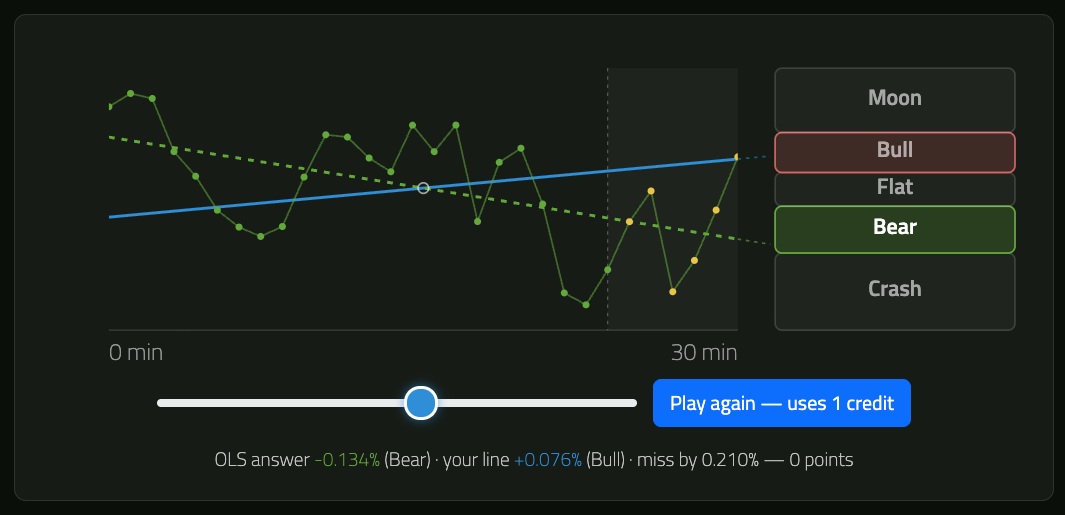
Feel the Trend — Go TrendPlay
TrendPlay turns Pretrend's resolution engine into a sixty-second game: aim your line at Crash through Moon as the prices land — the earlier you call it, the more points a win pays.
Go TrendPlayThree Worlds, One Point
Pretrend sits at the intersection of blockchain, artificial intelligence, and the humanities.
Blockchain is the truth axis. Vitruveo computes every trend natively and settles every market on-chain, so no participant has to take anyone's word for an outcome — they can verify it.
Artificial intelligence is the scale axis. The AI Notary watches data sources around the clock, explains why probabilities are shifting, and helps anyone design a well-calibrated market — work that once took a trading desk.
The humanities are the meaning axis. Markets are only interesting when they're about what people care about — music, movies, elections, culture, attention. Pretrend turns collective human judgment about those things into a measurable, tradable signal.
Vitruveo takes its name from Vitruvius, whose ideas Leonardo drew as a human figure inscribed in a circle — humanity at the center of geometry. Pretrend keeps that arrangement: the person stays in the middle; the mathematics surrounds them.
2026 Roadmap
The path to a live Pretrend oracle — quarter by quarter through 2026.
Shanghai Upgrade & Protocol Contracts
Upgrade protocol to Shanghai, remove legacy features and revise tokenomics.
View Explorer →On-Chain Trend Algorithm
Implement algorithms needed for Pretrend into the protocol as built-in smart contracts and deploy.
Try it out →Smart Contracts, Libraries & SDK
Develop and deploy the smart contracts that implement the Pretrend protocol, plus the libraries and SDK developers need to build on it.
Oracle & Launch
Complete development of Pretrend and launch the oracle alongside the reference site.
The Problem with Binary Markets
Current prediction markets force complex, continuous phenomena into binary outcomes. A market asking whether Bitcoin will reach $100,000 by a certain date loses all nuance about price movement.
If Bitcoin rises from $60,000 to $99,000, participants who bet on growth receive nothing — despite being directionally correct. Markets can't capture the magnitude of movement, only whether a threshold was crossed.
Setting thresholds is arbitrary and can make markets unbalanced from inception. Near-miss outcomes feel punitive to participants who correctly predicted direction but not exact magnitude.
The Trend Alternative
Real-world data moves continuously. Prices drift, metrics fluctuate, engagement rises and falls. A prediction system that captures directional movement and magnitude provides richer market dynamics and fairer outcomes.
Pretrend computes the trend slope over a defined time period using linear regression. The result is a percentage change that maps to one of five outcome buckets, each representing a range of possible movements calibrated to the specific data source.
Users purchase units in one of five buckets — from significant decline to significant growth. Every bucket's price climbs from a dime at open to a dollar at the close, so earlier buyers receive more units per dollar and better returns for early conviction.
Compare & Contrast
How Pretrend's trend-based model stacks up against the leading prediction markets.
| Capability | Pretrend | Polymarket | Kalshi |
|---|---|---|---|
| Captures magnitude and direction, not just yes/no | — | — | |
| Five graded outcome buckets | — | — | |
| Native on-chain statistical computation | — | — | |
| Timeslope pricing rewards early conviction | — | — | |
| Any time-series data source | — | — | |
| Cross-chain resolution | — | — | |
| Permissionless on-chain settlement | — | ||
| White-label, embeddable markets | — | — |
Why Now
Prediction markets have broken into the mainstream — billions in volume, millions of participants, headlines worldwide. The appetite is proven, and the category is still early.
Yet every one of those markets still asks a single yes-or-no question. Pretrend opens the same momentum to a richer kind of market — one that captures how far and which way, not just whether.
Polymarket and Kalshi figures are approximate, reported trading volumes.
A Virtuous Circle
Pretrend doesn't grow in isolation. A share of every dollar it earns flows back into the Vitruveo ecosystem — and that success compounds.
The 2% Revenue Share
2% of all Pretrend revenue is split straight back into the Vitruveo ecosystem:
Success compounds
Pretrend's success drives VTRU's, and VTRU's drives the whole Vitruveo ecosystem's — lifting asset value and rewarding VIBE holders at the same time.
Five Outcome Buckets
Every market has exactly five buckets representing ranges of trend movement, calibrated to each data source's historical volatility.
What You Can Predict
If it moves over time, it can become a market. A glimpse of what Pretrend makes possible:
Where does Bitcoin's 30-day trend land?
How strong is NVIDIA's momentum this quarter?
Is demand for AI compute still accelerating?
A creator's follower growth over 90 days
Which way is inflation trending?
A film's opening-month box-office momentum
Five graded outcomes — Crash, Bear, Flat, Bull, Moon — for any time-series the world produces.
System Architecture
Three primary components working together: the Vitruveo Oracle, the Notary Service, and the Marketplace Layer.
Oracle Contract
Vitruveo Blockchain
Stores market state, bucket thresholds, trend results, and fee accounting. Does not compute trends directly — stores results submitted by the authorized Notary.
Trend Precompile
Vitruveo Blockchain (native)
Computes OLS regression, R-squared, volatility, and bucket quintiles at compiled machine-code speed. What would be impossible in Solidity executes in microseconds.
Notary Service
Off-chain
Fetches external data, signs results, submits to Oracle. Batches updates for markets sharing the same data source. Sole authorized writer to the Oracle contract.
Marketplace Contract
BSC (or other EVM chains)
Handles unit purchases, pot tracking, and winner payouts. Deployed on external chains for accessibility and liquidity.
HOST Bridge
Vitruveo to external chains
Pushes resolution data cross-chain via HTTP Outbound Service Trigger. Validator-signed payloads ensure cryptographic proof of resolution.
Provider Modules
Off-chain
Per-source adapters that fetch, authenticate, and normalize external time-series data before it reaches the Notary for signing.
Trend Precompile
A native precompiled contract on the Vitruveo blockchain that performs statistical computation at the Geth client layer — compiled Go code, not interpreted EVM bytecode.
Mode 1: Full Analysis
Given a series of timestamp-value pairs, the precompile computes three values:
- Slope percentage — the fitted trend change from start to end of the series
- R-squared — confidence in the linear fit
- Volatility — sample standard deviation
Output: 96 bytes (3 × 32-byte signed integers, scaled by 1018)
Mode 2: Volatility Buckets
Given historical data and a window size, the precompile computes quintile thresholds for bucket boundaries:
- Calculates absolute percentage change for every rolling window
- Sorts deltas and returns 20th, 40th, 60th, and 80th percentile values
- These four thresholds define the five outcome buckets
Output: 128 bytes (4 × 32-byte unsigned integers representing quintile thresholds)
Timeslope Pricing
A dime at the open, a dollar at the close. Every bucket's price climbs with the clock and accelerates with demand — rewarding early conviction with better returns.
The Formula
timeDrift: steady climb to $1.00 at the 80% close · demandSlippage: every purchase pushes its bucket further ahead
Early Bird Advantage
| Buyer | Price | Units | Share | Return |
|---|---|---|---|---|
| Alice (early) | $0.21 | 466 | 53.1% | 4.78x |
| Carol (mid) | $0.44 | 226 | 25.8% | 2.32x |
| Frank (late) | $0.91 | 110 | 12.6% | 1.13x |
Same $100 stake, different timing. Betting closes at 80% of the market, when every bucket reaches $1.00 and the trend line is revealed.
Market Lifecycle
From creation to resolution — a complete flow across chains.
Create
Creator specifies data source, start time, and duration. Notary fetches historical data, computes bucket thresholds via the precompile, and initializes the market.
Trade
Users purchase units in their chosen bucket. Timeslope pricing fills each purchase, climbing with time and demand until the 80% close. The Notary updates the trend at the source cadence.
Resolve
When duration expires, the final trend determines the winning bucket. The Oracle pushes resolution via HOST to marketplace contracts, triggering payouts.
Data Sources
Pretrend supports any time-series data. Each source has a provider module that handles fetching, authentication, and normalization.
Cryptocurrency
BTC price, ETH price, trading volume, TVL
Equities
Stock prices, indices, forex rates
Social Metrics
Follower counts, view counts, engagement rates
Economic
Inflation, unemployment, interest rates
Elections
Polling aggregates, approval ratings
Commodities
Oil, gold, natural gas, agricultural futures
Marketplace Models
Multiple deployment models for different use cases.
One oracle on Vitruveo resolves markets wherever they live — and the more places Pretrend runs, the stronger the whole network becomes.
Primary Marketplace
Operated by Pretrend with access to all data sources. Full transaction fee retention. General-purpose interface for retail users.
White-Label
Third parties deploy branded marketplaces with custom domains and optional source filtering. 50/50 fee split with Pretrend. No upfront licensing fee.
Open-Source Starter Kit
React component library, contract ABIs, integration examples, and documentation for building custom marketplace experiences.
Security
Trust-minimized by design — every result is signed, on-chain, and independently verifiable.
Oracle Trust Model
The Notary is a trusted component. All submissions are signed and on-chain, creating an auditable history. The trend precompile is deterministic — anyone can verify results independently.
Data Integrity
OLS regression dampens outlier effects. Resolution intervals prevent flash manipulation. Multiple data points over market duration provide redundancy.
Void Protection
Markets are automatically voided if they receive fewer than 80% of expected updates. Participants receive refunds minus infrastructure costs already incurred.
Cross-Chain Fallback
If HOST delivery fails, marketplace contracts support manual resolution submission with Oracle signature verification.
The world runs on trends.Pretrend makes them tradable.
Interested in building on Pretrend or deploying a white-label marketplace?